


What Supplements Should I Take For Plantar Fasciitis?

Updated: Aug 23

If you’ve been dealing with plantar fasciitis, you’ve probably spent a lot of time thinking about what shoes to buy and searching for the best stretches or exercises.
But there’s another side of recovery that doesn’t get nearly enough attention: giving your body the nutritional support it needs to actually repair and rebuild damaged tissue.
Because what you do to your foot matters, but so does the environment you’re creating inside your body for healing to take place.
Because healing is about so much more than what you do to your foot. Your nutrition, sleep, activity level and overall health all influence your body's ability to repair and rebuild tissue.
And if you're deficient in certain nutrients, you may not be giving your body everything it needs to do that job well.
That's why I like to take a much more holistic approach to plantar fasciitis recovery.
We absolutely have to address what's happening mechanically at the foot, but I also want to create the best possible internal environment for that tissue to recover.
So in this blog, I'm sharing five supplements and nutrients that I think are worth knowing about if you have plantar fasciitis.
And I'll tell you what the research actually says, because some have much better evidence than others.
But I want to make one thing very clear before we start: none of these supplements is a cure for plantar fasciitis.
You cannot supplement your way out of a foot that doesn't have the capacity to handle the demands you're placing on it. But supplementation, along with good nutrition, may help give your body some of the building blocks it needs while you're doing the actual work of rehabilitation.
So let's start with one of my favorites.
Does Collagen Help Plantar Fasciitis?
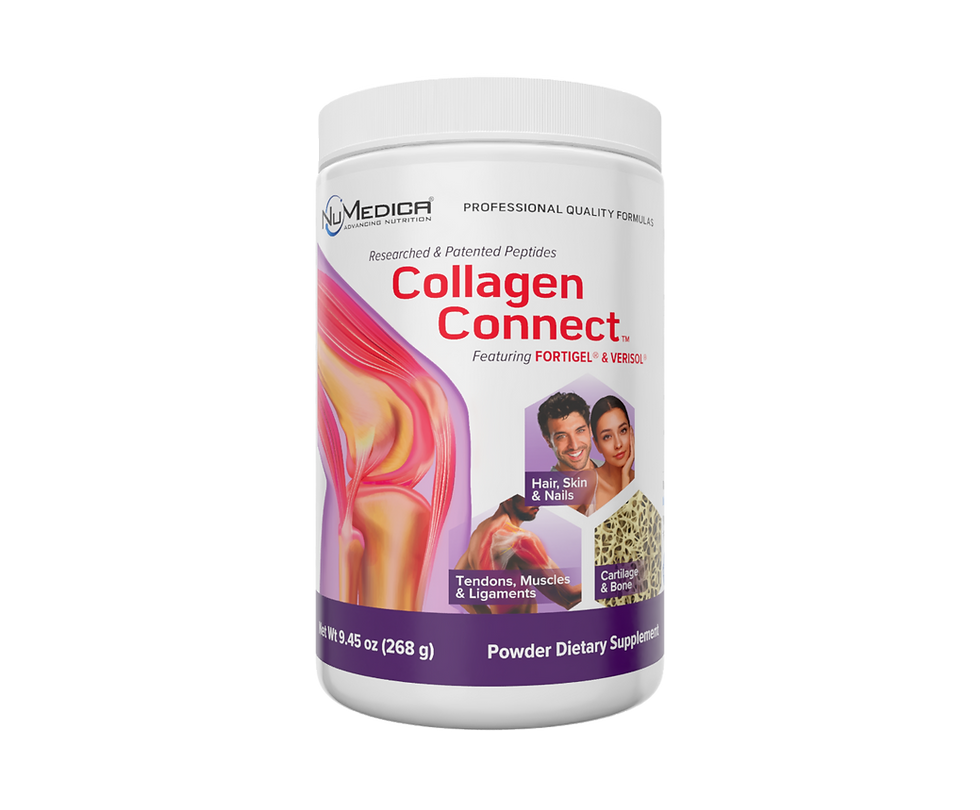
#1: Collagen Peptides
This one makes a lot of sense when we look at what the plantar fascia is actually made of. Your plantar fascia is a thick band of connective tissue, and collagen is one of its primary structural components.
So when that tissue is trying to remodel and become stronger, it needs the appropriate building blocks to do that. That's where collagen peptides come in.
Collagen peptides provide amino acids such as glycine and proline that your body uses in collagen production. And we've actually seen some really interesting research looking at collagen supplementation and connective tissue.
Research on collagen supplementation and tendon adaptation has found improvements in tendon structure and mechanical properties in some studies, particularly when collagen is combined with exercise.
And here's the part I REALLY want you to hear: Collagen appears to be most useful when it's combined with progressive resistance exercise.
And I love this because it reinforces something I've been teaching for years: your tissues need LOAD in order to adapt.
You don't just give the body collagen and magically grow a stronger plantar fascia. Mechanical loading provides the stimulus that essentially tells the tissue,
Hey, we need to get stronger here.
Then adequate nutrition provides some of the raw materials the body can use during that remodeling process.
So think of collagen as potentially supporting the construction project.
Progressive loading is still the foreman.
I recommend collagen peptides to most of my patients with muscle, joint & fascia pain. Other benefits include support for gut health, skin, nail, and hair strength.
#2: Vitamin C
This one doesn't get nearly as much attention, but if we're going to talk about collagen, we need to talk about vitamin C.
Because your body needs vitamin C for normal collagen synthesis.
Vitamin C acts as a cofactor for enzymes involved in forming and stabilizing collagen. In other words, your body doesn't just need the amino acids that make up collagen, it also needs the nutrients required to actually build and organize that collagen properly.
Now, that doesn't necessarily mean everyone watching this needs to run out and buy a giant bottle of vitamin C. You may already be getting plenty through your diet, especially if you're eating fruits and vegetables like citrus fruits, berries, kiwi, peppers, broccoli and leafy greens.
But if your diet is lacking in vitamin C-rich foods, it's something worth paying attention to, particularly if you're trying to recover from a connective-tissue injury.
So I like thinking of these first two together:
Collagen provides the building blocks. Vitamin C helps support the process of building collagen. And progressive loading provides the stimulus.
That's a pretty powerful combination.
Does Magnesium Help Plantar Fasciitis?

#3: Magnesium Glycinate
Next is magnesium, and specifically, magnesium glycinate.
Magnesium is involved in hundreds of biochemical reactions throughout the body. It plays an important role in normal muscle function, nerve function, energy production and bone health.
But magnesium has become particularly interesting in the plantar fasciitis conversation because of some newer research.
A recent study looked at people with chronic plantar fasciitis who took magnesium glycinate along with vitamin D3 for 12 weeks. Their pain and foot-function scores improved significantly.
Now, before everyone runs to the supplement aisle, there's an important limitation: there wasn't a placebo control group.
So we can't look at that study and say, Magnesium and vitamin D cure plantar fasciitis.
We don't know that.
But it certainly raises an interesting question about whether correcting nutritional deficiencies and supporting normal musculoskeletal function could be beneficial as part of a larger recovery strategy.
And that's exactly how I look at magnesium.
It's another piece of the puzzle — not the entire puzzle.
What Type Of Magnesium For Plantar Fasciitis?
If you’re considering magnesium for plantar fasciitis, magnesium glycinate is the form I typically recommend.
It’s well absorbed and generally easy on the digestive system, and magnesium plays an important role in normal muscle and nerve function.
Magnesium may be particularly helpful if your dietary intake is low or you’re deficient. While it won’t directly “heal” plantar fasciitis, correcting inadequate magnesium intake may help support normal muscle function and your body’s overall recovery process.
I generally recommend 300–500 mg daily, depending on the individual and the amount of elemental magnesium in the product.
Always check the Supplement Facts panel, since the amount of magnesium glycinate listed on the front of a product is not necessarily the amount of elemental magnesium you're actually getting.
Does Vitamin D Help Plantar Fasciitis?
#4: Vitamin D3
Number four is one I think we should be paying much more attention to: vitamin D3.
Vitamin D plays an important role in musculoskeletal health, including normal bone and muscle function. And vitamin D deficiency is very common.
The interesting thing about the study I just mentioned is that many of the plantar fasciitis patients actually started with low vitamin D levels. Their average level was around 17 nanograms per milliliter.
After supplementation, their vitamin D levels increased — and at the same time, their pain and function improved.
Again, we cannot say that vitamin D supplementation was responsible for the improvement. That's not what that study proved.
But if somebody has chronic plantar fasciitis AND they're deficient in vitamin D, that's certainly something I would want them to discuss with their healthcare provider.
And this is where I think blood work can sometimes be really useful.
Instead of randomly taking every supplement somebody recommends on YouTube, including me, find out whether you're actually deficient.
Because correcting a deficiency is very different from taking massive doses of something you already have enough of.
More isn't always better.
Does Turmeric Help With Plantar Fasciitis?

#5: Turmeric / Curcumin
And finally, let's talk about turmeric, specifically its active compounds called curcuminoids, including curcumin.
Curcumin has been studied quite extensively for its effects on inflammatory signaling and musculoskeletal pain. Research in other musculoskeletal conditions has shown some promising results for reducing pain and improving function.
But here's where we need to be careful with plantar fasciitis.
For years, plantar fasciitis was described simply as an inflammatory condition.
We now know it's much more complicated than that.
Especially when plantar fasciitis becomes chronic, we're often dealing with tissue degeneration, altered collagen organization and a mismatch between the amount of load being placed on the tissue and the tissue's ability to tolerate that load.
So I don't recommend turmeric because I think we simply need to "get rid of the inflammation."
I look at it as something that may help support the body's overall inflammatory balance and potentially help with discomfort while we're addressing the underlying problem.
And once again, there's that word: Support.
Because that's what every supplement on this list is doing.
The supplement I recommend has curcumin, boswellia serrata extract (frankincense), bromelain, ginger and other powerful anti-inflammatories.
Take a look at those ingredients here.
What Supplements Brands Are Good For Plantar Fasciitis?

One more thing that’s really important when we’re talking about supplements is quality. Not all supplements are created equal, and the cheapest bottle on the shelf isn’t necessarily giving you the same formulation, dose, purity or quality as a professionally formulated product.
I recommend looking for reputable manufacturers that use high-quality ingredients, follow good manufacturing practices and ideally use independent testing to verify what’s actually in the product.
This is especially important with something like curcumin, where the formulation can make a big difference in how well your body absorbs it.
This is also why I’m pretty selective about the supplements I recommend. I carry professional-quality supplements in my store that meet the standards I look for, and I’ve put three of my favorites, collagen peptides, curcumin and magnesium glycinate, together into a Plantar Fasciitis Supplement Bundle.
But before you buy supplements from me or anyone else, we need to talk about something that may be even more important, what you’re eating every day.
Now Let's Talk About Food
Before you go online and order five bottles of supplements, there's another part of this conversation that's arguably even more important.
What are you eating every day?
Because supplements are exactly what their name implies: they supplement your diet. They shouldn't be trying to compensate for a diet that's working against your recovery.
So if you're dealing with a stubborn musculoskeletal problem like plantar fasciitis, I encourage you to look at your overall eating pattern.
I like an anti-inflammatory, whole-food approach, lots of colorful vegetables and fruits, adequate protein, healthy fats, omega-3-rich foods, nuts, seeds and minimally processed foods.
At the same time, try reducing the things we tend to overconsume: highly processed foods, excessive added sugar, refined carbohydrates and heavily processed snacks.
You don't have to eat perfectly. And I'm certainly not suggesting that eating a cookie is why you have plantar fasciitis.
That's not how this works.
What we're trying to do is create an internal environment that gives your body everything it needs to do what it is already designed to do: repair, remodel and become stronger.
The Big Picture
So let's put all of this together.
Could collagen, vitamin C, magnesium, vitamin D and curcumin potentially support your plantar fasciitis recovery?
Yes. I think there's enough evidence to consider them as part of the bigger picture.
But will taking these five supplements make plantar fasciitis disappear if you don't address WHY the plantar fascia became overloaded in the first place?
Probably not.
And this is the mistake I don't want you to make.
You can take collagen every morning. You can take magnesium every night. You can eat the cleanest anti-inflammatory diet on the planet.
But if your foot is weak, if it can't tolerate load, if your toes aren't functioning properly, if you're wearing footwear that's interfering with natural foot mechanics, and if you never progressively strengthen the tissues that actually have to carry you through your day... we haven't fixed the underlying problem.
That's why I look at plantar fasciitis recovery from both directions.
We want to improve the external environment, how you're loading your foot, how you're strengthening it, how you're moving and what you're wearing.
And we also want to improve the internal environment, nutrition, adequate protein, vitamins and minerals, sleep, recovery and overall health.
That's what a truly holistic approach looks like.
And when those things start working together, you're not simply trying to make your heel stop hurting.
You're creating an environment where your body has the opportunity to actually recover.
Can I Treat Plantar Fasciitis At Home?
If you're ready to address the underlying causes of your plantar fasciitis and you'd like me to walk you through exactly what I recommend, from footwear and progressive strengthening to improving foot function, I have a complete step-by-step recovery plan. Get those details here.
And remember: supplements can support the process. Nutrition can support the process.
But ultimately, we still have to teach that foot to become stronger, more capable, and better able to handle the life you want to live.
Dr. Angela's Supplement List:


Comments